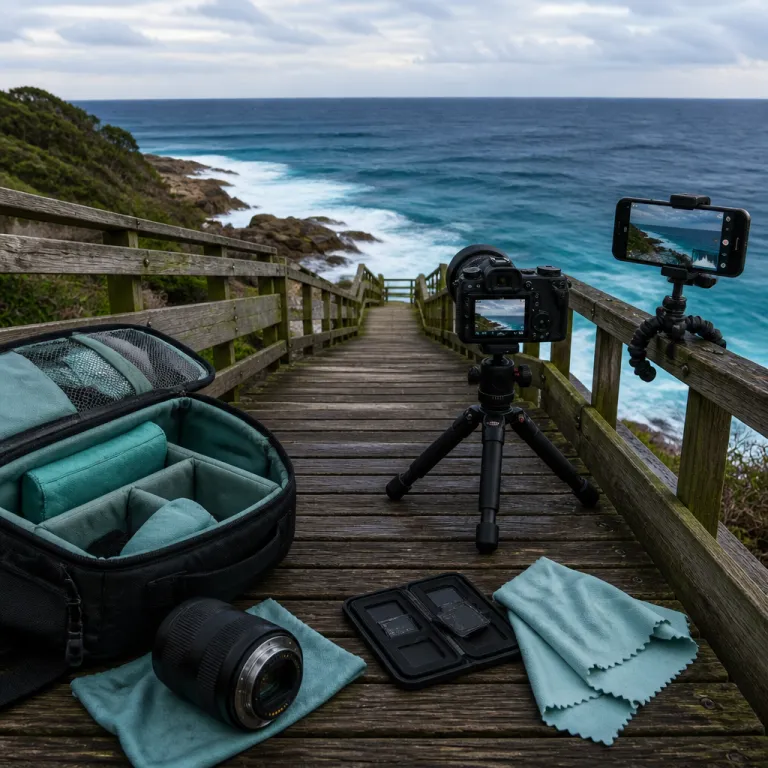
The new baseline: what your smartphone already does brilliantly
Your travel photography kit in 2026 still starts in your pocket. For most casual trips, that slim device already delivers the best balance between spontaneity, image quality, and comfort. You raise it, tap once, and the phone quietly stacks frames, reduces noise, and lifts shadows while you walk toward the next street corner.
Modern smartphones now act as multi focal length cameras, with ultra wide, standard, and short telephoto modules built into one compact slab. Computational photography handles the heavy lifting, so the average travel camera in a crowd is no longer a DSLR but a phone that edits every shot in real time. When you care more about sharing a clean image tonight than printing a metre wide panorama later, your handset often becomes your best camera without you even noticing.
Manufacturers have tuned sensors and software for travel photography, especially city breaks and bright coastal itineraries. Street food, markets, and quick portraits benefit from automatic HDR that protects highlights while keeping skin tones believable. If you rarely open a RAW file and do not plan to build a heavy camera travel kit, your smartphone is already the most capable compact solution you own.
TL;DR – smartphone vs mirrorless for travel photography
- Use only your phone when you travel light, share online, and mostly shoot in good light.
- Pack a mirrorless camera for low light interiors, night scenes, wildlife, or large exhibition prints.
- One lens is usually enough – a versatile zoom beats a bag of lenses you never mount.
- Accessories matter: tripod, batteries, and weather protection prevent missed shots.
Where mirrorless still wins: low light, control, and intent
There are still scenes where a dedicated mirrorless camera changes everything. Step into a dim cathedral in Palermo or a lantern lit alley in Kyoto and a larger sensor with a fast lens pulls detail from the shadows that a phone simply smears. A typical full frame sensor measures around 36×24 mm, compared with roughly 1/1.3-inch (about 9.6×7.2 mm) in many flagship phones, which means far more light per pixel and cleaner files at higher ISO. These dimensions follow the standard sensor formats documented by major camera manufacturers and technical references.
A full frame mirrorless body from Sony or Canon, paired with a 24 to 70 millimetre f/2.8 zoom, lets you shoot handheld at ISO 1600 instead of 6400 and still maintain rich image quality. You can drag the shutter to 1/10 second for motion blur in a Tokyo subway, or freeze a flamenco dancer in Seville at 1/500 second, because you control shutter speed, aperture, and ISO directly. When you need deliberate depth of field, such as isolating a tea master in Uji against a soft background, a phone’s tiny sensor cannot match the look of a fast lens on a larger imaging surface.
Mirrorless cameras also excel when you work slowly and with intention, such as photographing temple geometry in Kyoto at blue hour. For that kind of patient work, a lightweight tripod under 1.5 kilograms, a neutral density filter, and a weather cover turn your camera gear into a small field studio. If you want a deeper dive into composing with light and angles in Japanese temples, the in depth geometry of Japanese temples for photographers guide in this travel photography series is worth reading before you go.

| System | Typical sensor size | Usable ISO for clean files | Approx. travel weight | Typical cost range (body + main lens) |
|---|---|---|---|---|
| Smartphone (2026 flagship) | ~1/1.3-inch (≈9.6×7.2 mm) | ISO 100–800 | 200–250 g | Included in phone price |
| APS C mirrorless | ≈23.5×15.6 mm | ISO 100–3200 | 700–1,200 g | Mid range budget |
| Full frame mirrorless | ≈36×24 mm | ISO 100–6400+ | 1,000–1,600 g | Higher investment |
The one lens philosophy: packing light without missing the shot
Most travelers carry too many lenses and use none of them well. A single zoom lens that covers wide to short telephoto, such as a 24 to 70 millimetre kit lens on a compact mirrorless camera, will handle almost every travel situation. From a rooftop in Lisbon at sunrise to a back alley café in Buenos Aires, you can move your feet instead of swapping lenses in the dust.
Think of your mirrorless camera and lens as a unified travel photography system rather than a collection of toys. A full frame body like a Sony A7C series or a Canon EOS R8 with one high quality zoom gives you consistent image quality across your entire trip. You avoid the mental friction of deciding between lenses, which means you actually take the shot instead of hesitating with a bag full of options.
For travelers who still want a smaller option, high end compact cameras with a fixed lens and strong optical zoom can complement a 2026 smartphone setup. These premium compact models bridge the gap between phone convenience and DSLR style control, especially when you value a dedicated shutter button and physical dials. If you are planning refined getaways and want a simple but capable camera travel kit, the curated overview of spring break photography friendly destinations in the United States in this series pairs well with a one lens philosophy.
Accessories that matter and those you can leave at home
Once you have chosen between a smartphone only setup or a mirrorless camera kit, accessories become the quiet difference between frustration and flow. A lightweight travel tripod, ideally under 1.5 kilograms, lets you shoot long exposures of waterfalls in Iceland or night markets in Taipei. Add a simple neutral density filter and you can smooth water, blur crowds, and keep your ISO low for maximum image quality.
Spare batteries remain essential for any mirrorless camera, because cold mountain mornings in Patagonia or alpine nights in the Dolomites can halve battery life. A basic rain cover, even a clear plastic bag with a rubber band, protects your camera gear when a storm rolls over the Mekong or the Scottish Highlands. For a smartphone focused travel photography setup, a small power bank and a rugged case are the equivalent, keeping your best camera ready when the sky suddenly explodes with colour.
Some accessories are less critical than marketing suggests, especially for camera travel in cities. Heavy gimbals, oversized camera bags, and multiple specialty lenses often stay in the hotel while your phone does the real work. When you are weighing what to pack, remember that lighter gear also makes it easier to move quickly to safe shelter during extreme weather, and the practical resource on choosing the safest place during a tornado while you travel in this safety focused guide collection is as important as any new lens.
The honest calculation: editing, printing, and when to put the camera down
The real question is not whether a smartphone or mirrorless camera is objectively best, but which one serves the way you actually travel. If you rarely open Lightroom and prefer to share images straight from the road, a modern phone and minimal accessories will usually give you better final images because it edits for you. When you do plan to edit carefully and print large, a mirrorless camera with a larger sensor and high quality lenses still gives you files that phones cannot match.
Industry data from the Camera & Imaging Products Association (CIPA) shows that global mirrorless camera shipments reached roughly 6.2 million units in 2023, which confirms that serious travelers still invest in dedicated cameras. This figure is drawn from CIPA’s published shipment statistics for interchangeable lens digital cameras. At the same time, photography experts and lab tests from major review sites consistently show that smartphones with multiple focal lengths now cover most casual travel scenarios. As one expert style summary puts it, “Are smartphones sufficient for travel photography? Yes, for casual use; dedicated cameras offer higher quality,” and “Do mirrorless cameras outperform smartphones in low light? Yes, due to larger sensors and better optics.”
There is also the question of presence, which no sensor or price comparison can solve. Some evenings in Oaxaca or along the Croatian coast, the best travel choice is to leave both smartphone and mirrorless camera in your bag and simply watch the light fade. The most meaningful image you carry home might be the one you never shot, because you chose the walk behind the postcard instead of the postcard itself.
FAQ
Is a smartphone enough for serious travel photography?
A modern smartphone is enough for serious travel photography if your main goals are sharing online, creating small prints, and travelling light. Computational processing now delivers strong image quality in good light and handles most city and landscape scenes well. You may still want a mirrorless camera when you need clean low light files, fast autofocus for wildlife, or large exhibition prints.
When should I pack a mirrorless camera instead of relying on my phone?
Pack a mirrorless camera when your trip involves low light interiors, night markets, wildlife, or landscapes you plan to print large. A larger sensor and high quality lens give you more control over depth of field and cleaner files for editing. If you are leading a project, shooting for clients, or documenting a once in a lifetime expedition, a dedicated camera becomes the safer choice.
Is a full frame sensor necessary for travel, or is APS C enough?
An APS C mirrorless camera is enough for most travelers, offering excellent image quality in a smaller, lighter body. Full frame sensors shine when you regularly shoot in low light, push shadows in post production, or need very shallow depth of field. If weight and budget matter more than marginal gains, an APS C body with a good zoom lens is usually the smarter travel companion.
How many lenses should I bring on a typical trip?
For most trips, one versatile zoom lens is better than a bag of primes you rarely mount. A 24 to 70 millimetre or similar range covers wide city scenes, portraits, and moderate telephoto needs. Only add a second lens, such as a small prime or a longer telephoto, if you have a clear, repeated use case like wildlife or astrophotography.
Do compact cameras still make sense if my phone is already good?
High end compact cameras still make sense if you want a dedicated tool with better ergonomics, a larger sensor than your phone, and a strong optical zoom in a small body. They are especially useful for travelers who dislike changing lenses but want more control than a smartphone offers. If your phone already satisfies you and you do not enjoy carrying extra gear, you can safely skip a compact camera and invest in learning composition instead.